
Is Your Business Invisible on Google? A Local SEO Checklist
In today’s digital and AI-first visibility world, businesses must ensure they follow each checklist with precision, that could not leave any scope of failure. So first of all we need to make sure the visibility of business in Google and LLMs is actually doing good, otherwise the growth may face challenges due to higher competition.
In this blog, we shall go through some proven strategies to enhance Google search visibility.
Here are some of the local SEO ways to implement for Google search growth:
- Improve visibility in the geographical aspects that targets the customers as per their current locations in Google searches.
- If a business is visible in Google Maps search results, it will improve the visibility for your business location, services and products offered.
- Local Goggle mapping generates genuine leads and businesses gets more calls, directions requests, and website visits organically.
- The sharing of the genuine reviews helps the visitors to mofBusinesses needs to enlist their business over local directories and get the good ranking among the local competitors.
However, local SEO does not guarantee immediate rankings. Results depend on factors such as relevance, distance, prominence, competition, website quality, and the accuracy of your business information.
10 Essential Local SEO Checklist to Improve Google Visibility
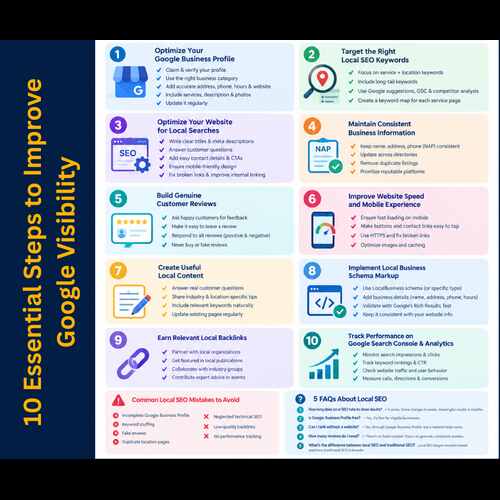
1. An Optimized Google Business Profile improves local search visibility
Your Google Business Profile defines your business identity online and helps in improves local search visibility. A clear NAP consistency, maps integration, business name, business hours, services listing and other useful information. All are essential for business online listing in GMB, so check for its status, whether it is claimed, verified, accurate, and complete.
If you operate a service-area business without a customer-facing location, configure the profile according to Google’s guidelines rather than displaying a residential address as a storefront.
2. Targeting the right & local SEO keywords improves searchability
By making a right keywords strategies any businesses can generate good traffic and potential leads. Local SEO keyword research helps you understand how potential customers search for your services and which geographical terms are relevant to your business.
Look for a combination of service-based, location-based, and long-tail keywords. Long-tail keywords are more specific search phrases that often communicate a clearer customer requirement. You can use Google Search suggestions, Google Search Console, keyword research tools, and competitor analysis to identify relevant opportunities. Avoid selecting keywords solely because they have high search volumes. Focus on terms that align with your services, target audience, service locations, and business objectives.
3. Optimize Your Website for Local Searches
Your website should clearly communicate what you do, who you serve, and where you operate.
Start with your homepage, service pages, contact page, and other important landing pages.
For effective local SEO, ensure that:
- Your page titles describe the service and relevant location where appropriate.
- Meta descriptions accurately summarize each page.
- Headings (H1-H6) explain the page’s main topic.
- Your content answers genuine customer questions.
- Your contact details are easy to find.
- Your website includes clear calls to action.
- Internal links connect related services and useful content.
- Your pages work properly on mobile devices.
Do not simply replace the city name on multiple identical pages to target different locations. Create location pages only when you can provide genuinely useful, location-specific information.
4. NAP consistency helps Google to identify your business.
Search engines and customers need reliable information about your business. The complete business information like business name, address, and phone number, business hours, services details and other relevant information increases trust and credibility. Check your business name, address, phone number, website URL, and opening hours.
Correct outdated listings and remove duplicate listings where possible. Prioritize reputable directories instead of submitting your business to hundreds of low-quality websites simply to acquire backlinks.
5. Build Genuine Customer Reviews
Customer reviews influence how people evaluate local businesses. They can help potential customers understand service quality, communication, reliability, and overall customer experience. Google also considers review-related signals as part of local prominence, although reviews alone do not determine rankings.
To build a trustworthy review profile:
- Ask satisfied customers to share honest feedback.
- Send a direct link to your Google review page.
- Make the review process simple and convenient.
- Respond professionally to positive and negative reviews.
- Address genuine customer concerns where possible.
- Avoid purchasing reviews or posting fake testimonials.
Do not offer incentives in exchange for Google reviews, and do not selectively request positive reviews while discouraging negative feedback. When responding to criticism, remain calm and avoid disclosing private customer information. A helpful response can demonstrate that your business takes feedback seriously.
6. Improve Website Speed and Mobile Experience
Many local customers search for services using their smartphones. A slow or difficult-to-use website can cause visitors to leave before contacting your business.
Website performance is therefore an important part of your overall local SEO and conversion strategy.
Check the following:
- Does your website load efficiently on mobile devices?
- Are buttons and contact links easy to tap?
- Is your text readable without zooming?
- Do images load properly?
- Is your contact form working?
- Can customers find your services without unnecessary clicks?
- Does your website use HTTPS?
- Are there broken links or intrusive pop-ups?
Use Google PageSpeed Insights to review performance and Core Web Vitals. Pay attention to loading performance, interaction responsiveness, and layout stability.
Compress large images, remove unnecessary scripts, review caching settings, and use reliable hosting where appropriate. Avoid installing multiple plugins that perform the same optimization function.
A fast website does not automatically secure high local rankings, but it can improve usability and reduce friction for potential customers.
7. Human written and useful local content build credibility fast
Any business shall go for the human written and SEO-friendly ideas and publish it as per their niche areas. As we know by publishing relevant content repeatedly helps your business to crawl fast in Google search engines. Also, a proper keywords targeting and content optimizations helps in improving the search engine rankings for the specific contents.
8. Implement Local Business Schema Markup
Structured data helps search engines understand information about your business and website. Depending on your business type, you may use appropriate Schema.org markup, such as Local Business or a more specific supported subtype.
Relevant properties may include your business name, address, telephone number, URL, opening hours, and other applicable details.
Ensure that structured data accurately reflects information visible on your website. Validate the markup using Google’s Rich Results Test where applicable and check for errors.
Remember that adding schema markup does not guarantee a rich result or improved rankings. It is one part of a broader technical SEO strategy.
9. Earn Relevant Local Backlinks
Backlinks are links from other websites to your website. Relevant, trustworthy links can support your website’s authority and visibility.
For local SEO, prioritize meaningful relationships and genuine mentions rather than collecting large numbers of low-quality links.
Potential opportunities include:
- Local business associations.
- Industry organizations.
- Community events and sponsorships.
- Relevant local publications.
- Business partnerships.
- Expert contributions to reputable industry websites.
- Local resources that genuinely reference your services.
10. Track Performance analytics
Local SEO requires ongoing measurement. Without tracking, you may not know whether your work is improving visibility or generating meaningful business outcomes.
Use Google Search Console to monitor:
- Search impressions and clicks.
- Queries that bring visitors to your website.
- Click-through rates.
- Average search positions.
- Indexing problems.
- Page-level search performance.
Use Google Analytics 4 to understand website visits, user behavior, and relevant conversion events. Where available, review Google Business Profile performance metrics such as calls, website clicks, and other customer interactions. The available metrics may vary. Track meaningful business outcomes alongside rankings. A keyword moving upward in search results is useful, but qualified leads, phone calls, bookings, and sales matter more to business growth.
Common Local SEO Mistakes to Avoid
Even a well-designed website can struggle to attract local customers when important optimization issues remain unresolved.
Watch out for these common mistakes:
- Incomplete Google Business Profile: Missing information can make it harder for customers to understand your business.
- Keyword stuffing: Repeating location names unnaturally can damage readability and does not guarantee better rankings.
- Fake reviews: Artificial reviews violate platform policies and undermine customer trust.
- Duplicate location pages: Publishing near-identical pages for multiple cities provides little value to users.
- Neglected technical SEO: Indexing errors, broken links, and poor mobile usability can interfere with website performance.
- Low-quality backlinks: Irrelevant links and manipulative link-building practices can create SEO risks.
- No performance tracking: Without measurement, it is difficult to determine which actions produce meaningful results.
The most effective local SEO strategy focuses on accuracy, relevance, trust, helpful content, and a positive customer experience.
Frequently Asked Questions About Local SEO
1. How long does local SEO take to show results?
Local SEO results can be seen by many variable factors. It includes website quality, business profile completeness, and the actions implemented. Some improvements may be visible within weeks, while meaningful ranking and lead improvements can take up to 3-6 months minimum to get a good result.
2. Is Google Business Profile free?
Yes. Creating and managing a Google Business Profile is free for eligible businesses. You should follow Google’s eligibility rules and keep your business information accurate.
3. Can my business rank on Google without a website?
Yes. An eligible business can appear in Google Maps and local results through its Google Business Profile without having its own website. However, a website can provide additional information, showcase services, build trust, and support organic search visibility.
4. How many Google reviews does my business need?
There is no fixed number of reviews required to rank locally. Focus on earning genuine reviews consistently, responding professionally, and delivering a good customer experience. Review quality, relevance, recency, and the competitive environment can all matter to customers and local visibility.
5. What is the difference between local SEO and traditional SEO?
Traditional SEO focuses broadly on improving visibility in organic search results. Local SEO specifically emphasizes visibility for geographically relevant searches and may include Google Business Profile optimization, local citations, reviews, location-specific content, and local prominence signals. Both approaches can work together.
Conclusion: Make Your Business Easier to Find on Google
If your business is invisible on Google, the answer is not necessarily to publish more content or build more backlinks. Start by identifying the underlying problems.
Check your Google Business Profile, target relevant local SEO keywords, improve your website, correct inconsistent business information, earn genuine customer reviews, and monitor performance consistently.
Remember that local SEO is an ongoing process, not a one-time task. Regular improvements can help your business become more discoverable, establish credibility, and connect with customers who are actively looking for your services.
Ready to Improve Your Local Search Visibility?
At Markentix Wave, we help businesses strengthen their online presence through strategic SEO, Google Business Profile optimisation, website optimization, content marketing, and digital marketing solutions.
Let’s make your business easier to discover online.
Visit: https://www.markentixwave.com
Email: info@markentixwave.com
Contact Markentix Wave today to discuss your SEO goals and build a strategy tailored to your business.