
How to Turn Website Visitors Into Paying Customers
Every business needs good website traffic to sustain itself in this highly competitive AI era. And getting traffic to your website requires great digital marketing and SEO strategies. As we know, getting bulk traffic to your website does not guarantee that the business will grow or that all traffic is convertible.
Many customers visit numerous websites each month to find products and services, yet not everyone makes a solid purchasing decision by requesting a quote or final proposal. However, the most challenging situation is when a website visitor does not convert into a potential lead. As every website’s visitor may have different intentions, some may come only for browsing, or some may come for commercial or transactional needs online. Therefore, the website’s experience does matter for any customer, and if they are genuinely seeking the services or product, it is very easy, with a good marketing strategy, to convert visitors you already have.
In this guide, we will explore some advanced practices to improve your website’s performance that organically turn visitors into paying customers.
Smart Ways to Turn Website Visitors Into Paying Customers
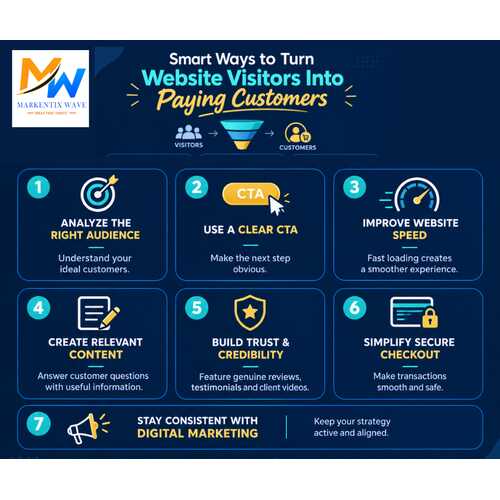
Here are some smart tricks that will surely help your website to grow and track the convertible leads organically:
1. By Analyzing the Right Audience
Identifying the right potential customer is a crucial task in this competitive world; even if a customer browses your website, it doesn’t guarantee they are interested in purchasing. So, identifying the correct audience’s needs, geography, challenges, and other factors that influence it is essential. Consequently, there are many AI-SEO-enabled tools that track it with precision.
But when a website is engaging and carries the right digital marketing and content strategies, it helps deliver quotations, invoices, proposal requests and enquiries through safe form submission by browsers. Consequently, it creates a funnel that segregates customers by location, budget ranges, preferences, timing and duration.
2. A clear CTA and a compelling website draw attention
Whenever a visitor comes to your website, it takes only 2-3 seconds to decide whether to stay or bounce back for them. In this case, if your website is not engaging and offering a clear CTA for what they may be seeking, they will bounce back. So, your website should offer clear services/products, images, an engaging and eye-catching theme, and related factors. Also, if the website offers products and invites visitors to visit the store, it can offer good deals, discounts and Google Maps integration with good reviews.
3. Fast website loading enhances user experience
A SEO & user-friendly website simplifies the website’s structure, and customers find it easy to use to explore information, daily deals, contacts, and other relevant inquiries. Mobile should pass the Core Web Vitals on both Mobile and desktop views, and there are numerous tools that check page speed optimisations and provide a full analytics report of LCP, FCP and others.
Website speed also influences the user experience, which can be corrected by image and video compression, file renaming as per the topics, clearing the cache, and addressing other performance problems.
4. Create Valuable and Relevant Content
Your website content should answer the questions customers ask before making a decision. When visitors find useful information, they are more likely to view your business as a credible source of guidance. Develop content around customer problems rather than focusing exclusively on your products or services. This may include informative blog articles, practical guides, service comparisons, frequently asked questions, checklists, and case studies.
Use clear headings, short paragraphs, examples, and actionable advice. Avoid unnecessary jargon and unsupported promises. Explain what customers can reasonably expect and how your process works. Search engine optimisation can help your content reach people who are actively looking for answers. Conduct keyword research, write descriptive titles and meta descriptions, use relevant internal links, and create content that satisfies search intent.
5. Build trust & credibility with genuine Reviews, Testimonials, and client videos
For any business building trust and credibility with genuine review submissions through maps and Google reviews links, real testimonials, case studies, portfolios and other business information. As we know, people first check the real reviews online and testimonials that explain the customer’s experience or the value received. As well as real customer videos, case studies should describe the initial challenge, the work completed, and the outcomes that can be supported by evidence.
6. Smooth and safe transactions process
Websites shall ensure the submission form works across devices and that users receive a confirmation after submitting it. And once the form is submitted, the payments should be safe and secure. Also, display prices, shipping information, payment methods, return policies, and additional charges clearly where applicable. For service businesses, offer convenient contact options and explain what happens after someone submits a form and submits on the payment links.
7. Consistent Digital Marketing Strategy Implementation
A website performs best when it supports your wider marketing activities. Search engine optimisation, social media marketing, local SEO, and content marketing can attract relevant people, but the website needs to turn that interest into action. Ensure that your advertising promises match the landing page. If an advertisement promotes a specific service, send visitors to a page about that service rather than forcing them to search your homepage for details.
Conclusion: Turn Website Traffic into Real Business Growth
Learning how to turn website visitors into paying customers requires more than attractive design or higher traffic numbers. It involves understanding your audience, communicating a clear value proposition, improving user experience, publishing relevant content, building trust, and making conversions simple. Every improvement should help visitors answer three questions: Is this business right for me? Can I trust it? What should I do next?
Start by reviewing your homepage, service pages, mobile experience, enquiry forms, and conversion tracking. Identify the biggest obstacle in the customer journey and address it first. Then measure the results and continue improving. At Markentix Wave, we believe digital growth begins when strategy, content, user experience, and search visibility work together. With the right approach, your website can become more than an online presence—it can become a valuable channel for qualified enquiries and long-term business growth.
Frequently Asked Questions
1. How can I turn website visitors into paying customers?
Start by understanding your audience and presenting a clear value proposition. Improve website speed and mobile usability, publish helpful content, display genuine trust signals, simplify enquiry forms, and use strong calls to action. Track conversions to identify which improvements produce better results.
2. Why does my website get traffic but no sales?
Several factors may contribute, including irrelevant traffic, unclear messaging, weak product or service pages, slow loading speed, limited trust signals, complicated checkout processes, or ineffective CTAs. Analyse visitor behaviour and conversion data to identify the main barrier before investing further in traffic.
3. What is a good website conversion rate?
There is no single conversion rate that suits every business. Results vary by industry, traffic source, offer, pricing, audience intent, and the action being measured. Establish a reliable baseline and compare performance over time while prioritising qualified leads and profitable sales.
4. Does SEO help convert website visitors into customers?
Yes. SEO can attract people searching for products, services, and solutions related to your business. However, traffic alone does not guarantee conversions. Relevant landing pages, persuasive content, credibility, a useful user experience, and clear next steps are needed to turn search traffic into enquiries and sales.
5. How can a digital marketing agency improve website conversions?
A smart digital marketing agency can review website content, user experience, SEO, analytics, landing pages, and calls to action. It can identify barriers, recommend improvements, and measure outcomes through conversion tracking. The strategy should reflect the business’s goals, audience, budget, and sales process.
Ready to Turn More Visitors into Loyal Customers for the Long-Term?
Your powerful SEO and leads making strategies is now possible with Markentix Wave. Get the free proposal on your complete website audit and digital marketing strategies to turn your website traffic into potential leads that will get more conversion.
Partner with Markentix Wave today! Request a Free Website Audit: https://www.markentixwave.com/free-website-audit
Contact Markentix Wave:
Website: https://www.markentixwave.com/
Email: info@markentixwave.com
Call/WhatsApp: +91-9211033010
Website Conversion Digital Marketing Lead Generation SEO Expert Conversion